Summer Orchid Care
The American Orchid Society is a horticultural society that promotes and supports the passion for orchids though education, conservation, and research. This month Bridget shares tips from AOS contributors Ned Nash and James Rose to care for your orchids in March and April, and upcoming programs from the AOS.
By Bridget Kerans, American Orchid Society Representative
Summer presents challenges in the form of increased pest activity, fungal and bacterial problems in traditionally wet areas and desiccation in those areas with Mediterranean-like climates where summers are typically quite dry. Observation is the watchword for the summer months. Careful observation of your plants is the best way to identify small problems before they become big problems, and in the summer, the time between these two events is dramatically shorter due to higher temperatures. The earlier you catch a problem, the easier it is to control.
Pest Control
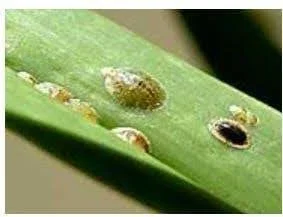
Soft brown scale
For small collections, the best thing to do is to physically wipe insects off, clean the plant and treat it with insecticide. Even for indoor collections – an open window is a liability where pests can crawl in. Spider mites can float on a gentle breeze, so they are the most commonly found indoors as a surprise infestation. No need to be paranoid – just observe your plants regularly to nip infestations in the bud. If you haven't been watching carefully and the infestation gets out of control, you might have to use stronger insecticides or chemicals. Few pesticides are specifically rated for use on orchids but you can use any that are labeled for ornamentals. Use care and ALWAYS follow the label directions. Failure to follow the instructions on the pesticide or fungicide label may result in dead plants – and pests that laugh at you. Remember, consistency is key to getting rid of pests – don’t think spraying once is enough. At MINIMUM indoors, one should spray a separate 3 times, with a few days in between the treatments/sprayings.
Pests and Fungi in Drier Environments
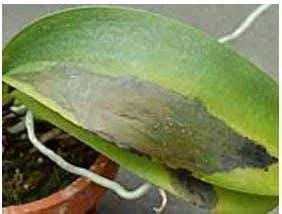
Bacterial rot on
Phalaenopsis
leaf.
In areas with dry summers, mites can be a serious problem especially on thin-leafed orchids. These creatures attack the surface of the leaves producing a sort of rough, silvery appearance. Mites do not like humid conditions so efforts to increase humidity are beneficial, but you will still need to either use a beneficial predator of mites or spray with miticides. Light infestations can be controlled by thoroughly cleaning plants but in hot, dry climates light infestations rapidly become serious and control is best accomplished by the use of a miticide.
Pests and Fungi in Wetter Environments
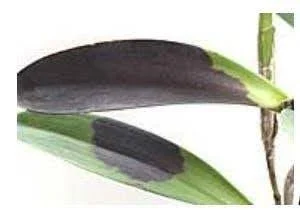
Black rot. A fungal disease on Cattleya leaves.
Frequent rain, wet foliage, and high humidity encourage the spread of fungal and bacterial diseases. Bacterial diseases do not respond to fungicides and vice versa so it's very important to know which disease you are dealing with. Perhaps the easiest way to distinguish between the two is by smell. The most common bacterial disease in orchids produces a foul smell often likened to dead fish. If you've ever had cut flowers stand too long in water you know the sort of smell we're talking about.
Plant diseases and rots spread much quicker than pest infestations do! Bacterial diseases kill plants especially rapidly and time is of the essence. Both bacterial and fungal diseases are spread by splashing water (from rain or watering) and cross touching, via human hands or critters roaming about in your space. It’s also good, in addition to just spraying bactericides and fungicides to cut off infectious lesions. Use a clean cutting tool like a single-edge razor blade, cut off the infected tissue as well as at least an inch of clean, green area and then treat the cut surface with a fungicide. Even if the problem is bacterial, you don't want a fungal infection to start in the wound. Cinnamon (yes the common spice, but only if freshly ground), is effective against fungal diseases and this can be used to coat the cut surface as well. It's perhaps not as effective as a chemical fungicide but it's readily available and does work. Physan is a catch-all treatment spray for fungi and bacteria, though it’s not that powerful.
In wet summer areas, the key to control is to keep your plants as dry as possible, which can be best done by increasing light and airflow. When you water, try to do so as early in the day as possible. This will allow adequate time for the foliage to dry before nightfall.
Dry Environments in General
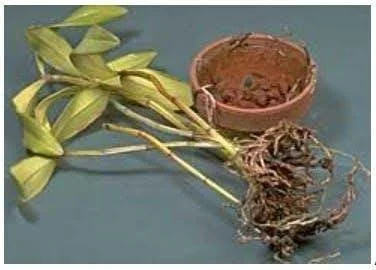
A desiccated Cattleya - note lack of live roots.
The bane of orchid growers in these areas is extremely low humidity and this leads to two issues. The first of these is an increase in the rate at which plants dry out and the other is the ever-present mite issue.
Orchids in dry summer areas dry out much more rapidly than they did in the winter. Depending on temperature, plants watered every two weeks in the winter may need to be watered every day in the summer. Nothing will take the place of careful observation. If you have an extensive collection of plants, you might want to consider installing a misting system similar to those used in open-air restaurants in dry areas. Low pressure units that install on hose lines are inexpensive and work reasonably well to raise humidity as well as cool the growing area somewhat.
Your Frenemy, the Sun
While plants are living solar panels, and in general, more light is good, solar radiation is much more intense in the summer. Plants that have been living happily in full sun all winter may need a little extra protection (shade) when the sun is the strongest or during the late afternoon when the temperatures are highest. Orchids grown in greenhouses or outdoors are easily sunburned, so you should take care when moving plants around, especially if you are moving plants grown inside during the winter to a spot outside for the summer. Sunburn, while not in itself a serious problem, is irreversible and will make your plants look ugly. In serious cases the plant can be killed outright and any leaf damage is an invitation to a secondary infection in the damaged area.
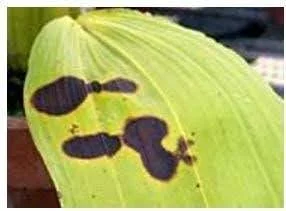
Sunburn on a Bifrenaria leaf.
Orchid foliage should be a light yellow-green – chartreuse, ideally. The first sign of too much light is often pale canary-yellow or pale yellow foliage (not to be confused with saturated “school bus yellow” foliage, which is indicative of water problems or something else). If left alone, this canary-yellow foliage will eventually turn white and then pale grey or pale grey-brown and dry as the sunburned area dries out. If the problem is caught before the chlorophyll has been completely destroyed it is often possible to reverse the damage. Once white spots or sunken areas have appeared, the damage is irreversible, and the best thing one can do is stop further progression with more shade.
Making the Most of the High-Growth Season
Because of the increased light and temperatures, your plants will benefit from more fertilizer (increased frequency NOT concentration). This is especially true for those varieties that put out new growth during this time. Avoid fertilizers that contain significant amounts of urea. Urea requires soil organisms to convert it to forms usable by orchids and the process liberates significant amounts of acid. If you are growing in a predominantly inorganic media like lava rocks or LECA, soil organisms aren't prevalent and these media have poor buffering capacity. If you are growing in fir back media, as the medium ages, it naturally becomes more acidic and less able to buffer the pH shifts caused by metabolism of urea.
Making the Most of the High-Growth Season – Outdoors and in Greenhouses
Plants will dry out faster from the increased temperatures, and the roots may desiccate, so it’s important to ensure that the humidity is elevated and watering is increased to reduce desiccation as much as possible. Some orchids like Bulbophyllum and black-haired Dendrobium (Nigrohirsute-type) are triggered to bloom with high humidity.
When fertilizing, to avoid root damage, water your plants first before fertilizing. This way the roots will be wet and much less easily damaged by the salts in the fertilizer solution.
Making the Most of the High-Growth Season – Indoors
Summer is a kind season to all plants, regardless of whether or not they are indoors. During the summer, growth of plants indoors is the greatest, much like it is outside. One of the benefits of growing indoors is the ability to grow plants in your climate-controlled home. While you may need to water daily from the excessive heat of the greenhouse or dryness outdoors, indoors, you get all of the warmth and all of the light, but without the harsh environmental swings. Just check the media, which may dry out faster than other seasons, if you don’t hit the air-conditioning hard and let your apartment or home heat up a bit. If your home is climate-controlled and well-insulated, you may notice that your plants are drying out at the same rate no matter which season it is.
The AOS thanks Ned Nash and James Rose for this essay.
**MEMBERS ONLY**
Catasetum Culture with Scott Elliott
Scott Elliott
Thursday, June 11th, 2026
7:30 PM CST
Join Scott Elliot of Maneki Hill Orchids, who will talk about hybridizing and growing catasetums.
The Next Issue Of ORCHIDS Magazine:
Coming in the June 2026 Issue
Tom's Monthly Checklist by Thomas Mirenda
Questions and Answers by Ron McHatton
For the Novice - Rot Root Caused by Rhizoctonia by Sue Bottom
Membership Committee Update -James Sim: From Jakarta to Australia: A Young Judge's Orchid Path by Deb Boersma
The Orchid Cultivation Project by Jana Butcher, Bridget Andoe and Marinel Kelley - Foreword by Eron Borne
Conservation Update - Are Endophytic Fungi Invisible Allies that Protect Guarianthe skinneri, a Beautiful Orchid from Southeast Mexico? by Fabiola Hernández Ramirez and Anne Damon
Collector's Item - Oncidium leucochilum by Judith Rapacz-Hasler
Orchids Illustrated - Nervilia - Shield Orchids by Wesley Higgins and Peggy Alrich
Cattleya violacea Hybrids: Part 3: The 21st Century by juraj Kojš
Dresden, Germany: Inside the World Orchid Conference, 2026 by Roland Schettler
Orchids, Friendships, Conservation and Science: Four Days at the 24TH World Orchid Conference in Dresden by Kay Perry
Dendrobium and Its Relatives - Part 20: Section Aporum by Jim Cootes
My Favorite Orchid - A Dendrobium nobile Hybrid by Nancy Marley
