
Monthly Checklist for July and August
The American Orchid Society is a horticultural society that promotes and supports the passion for orchids though education, conservation, and research. This month Bridget shares tips from AOS contributors Ned Nash and James Rose to care for your orchids in March and April, and upcoming programs from the AOS.
By Bridget Kerans, American Orchid Society Representative
Hello all! I just have some reminders for those whose orchids are out camping, during the heat they will be exposed to. Use some sort of shade for them, sunshade cloth for example, hopefully there is access to air circulation, and keep an eye on the watering. They need some but overdoing it will cause root rot.
Other than that I hope everyone have a great and safe 4th of July, and Happy 250 Birthday America!
On to the offerings of the AOS!
Cattleya
Cattleyas this month require careful attention to their watering and fertilizing needs owing to characteristically high temperatures. Evaporative cooling is a must in areas of the country where it is effective. Where it is not (the more humid regions), care needs to be paid to proper venting to keep temperatures within reason. Bottom vents in conjunction with top vents provide enough rising airflow to help keep plants cool. Increased air flow lessens humidity and dries plants out more quickly, necessitating more frequent damping down and watering, in areas where high humidity is not a problem. Higher light and heat indicate more fertilizer. The growths your plants are making now are the source of this autumn, winter and spring's blooms, so applying adequate fertilizer this month is the best way to ensure future blooms. Higher temperatures and humidity may also lead to fungal or bacterial rot problems, so it is important to closely observe your plants for any early indication of problems. Pests are also at a high point this month for the same reason.
Oncidium Intergenerics
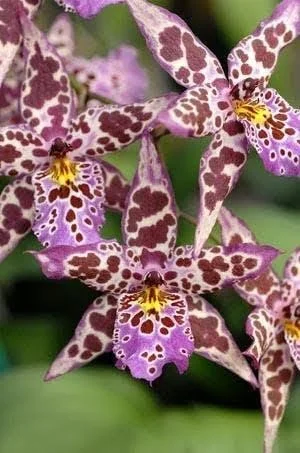
Aliceara Diana Dunn 'Newberry' is a good example of the colorful patterns that Oncidium intergeneric hybrids offer.
Many of the intergeneric crosses with oncidiums, will be blooming now. Take special care to train the spikes for best floral display. Keep plants under fairly shady conditions. Watch for snails and slugs.
Paphiopedilum
Cooling and air circulation are especially critical in these two months to prevent stress and avoid disease problems. Watering needs to be closely monitored to ensure that plants do not dry out. Warmer-growing hybrids will be at the peak of their blooming, with attention needing to be paid to staking of spikes. Look for water lodging in growths, which can rot emerging spikes and lead to the loss of the entire growth.
Phalaenopsis
Most, if not all, potting should be complete by now. This month and next are when these plants achieve their maximum growth. This growth will be that from which they set their spikes for the coming season. The more leaves the plants grow, the better potential for spiking will be realized. Growers in cooler areas such as the Pacific coast have the advantage this month, should they choose, of cooling for early season spikes. Lots of heat and light call for liberal applications of water and fertilizer.
Cymbidium
Summer can be the most rewarding season for cymbidiums. Growths should be coming strong now. The leaves of the new growths are best when they are broad and fairly stiff. The color should be a light green to nearly yellow. Early flowering varieties should be showing flower spikes, so move the plants into a cooler area with lower light. For mid-season varieties, lower the dosage of nitrogen to assist in spike initiation.
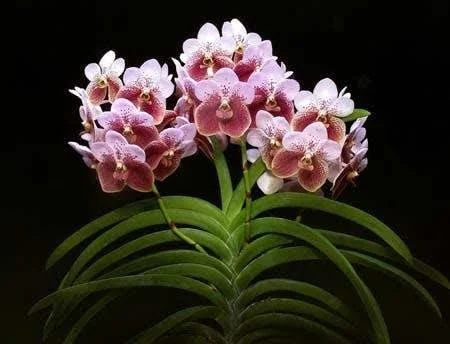
The Philippine species, Vanda sanderiana, rewards growers with massive heads of flowers at the end of sumer.
Vandaceous
Plants will be growing quickly now and really enjoying the hot humid days so similar to their native habitat. Watch for pests though, as many of these also enjoy the same conditions as the plants. Check flower spikes so that they can extend unimpeded for the best flower presentation later.
High-Elevation Plants
For cooler-growing plants, such as masdevallias, other pleurothallids and the like, the next few months will be a challenge. During the hottest times, keep your plants more shaded and be sure to keep the humidity level much higher. Do not let plants dry out. Delay any potting until the weather cools.
The AOS thanks Ned Nash and James Rose for this essay. Updated to current genera names (July 2024).
**Open to all**
Greenhouse Chat July 2026
Ron McHatton
Thursday, July 9th, 2026
7:30 PM CST
Join Dr. Ron McHatton as he answers your questions about all things orchids. Please send your question and pictures to Sandra Svoboda at greenhousechat@aos.org by July 5, 2026.

**Open to all**
Take a Virtual Trip to Dresden, the 2026 World Orchid Conference
Kay Perry, IOS Member!
Wednesday, July 15th, 2026
7:00 PM - 8:00 PM CST
Join orchid expert Kay Perry for a virtual journey to Dresden, host city of the World Orchid Conference 2026.
**Members Only**
A Visit to the Eric Young Foundation in England
Greg Griffis
Tuesday, July 21st, 2026
7:30 PM CST
This is a webinar on the Eric Young Foundation in Jersey, England with Greg Griffis, the new curator.
The Next Issue Of ORCHIDS Magazine:
Coming in the July 2026 Issue
Tom's Monthly Checklist by Thomas Mirenda
Questions and Answers by Ron McHatton
For the Novice - Give Us Air! The Importance of Fresh Air by Sue Bottom
Membership Committee Update -Rooted in Curiosity. The Orchid Journey of Alejandro Montoya Sandoval by Deb Boersma
Collector's Item - Cattleya velutina Rchb. f. 1870 - The velvety Cattleya by Judith Rapacz-Hasler
Orchids Illustrated - Women Illustrators: — Elizabeth and Margaret Wharton by Peggy Alrich and Wesley Higgins
Affiliated Societies Update - Expanding Impact Through Partnership: An Affiliate Society’s Collaboration with the American Orchid Society by Jamie Krochmal, Don Greaser, and Vijai Singh.
Energy Efficient Greenhouse Design by Douglas C. Needham
The Amazing Spider Orchids - The Genus Caladenia by Jacopo Calevo
Vanda coelestis (Rchb.f.) Motes - A New Combination with Taxonomic and Horticultural Significance by Martin Motes, PhD, and Jason L. Downing, PhD
My Favorite Orchid - Dryadella simula by Josephine deBeaubien
